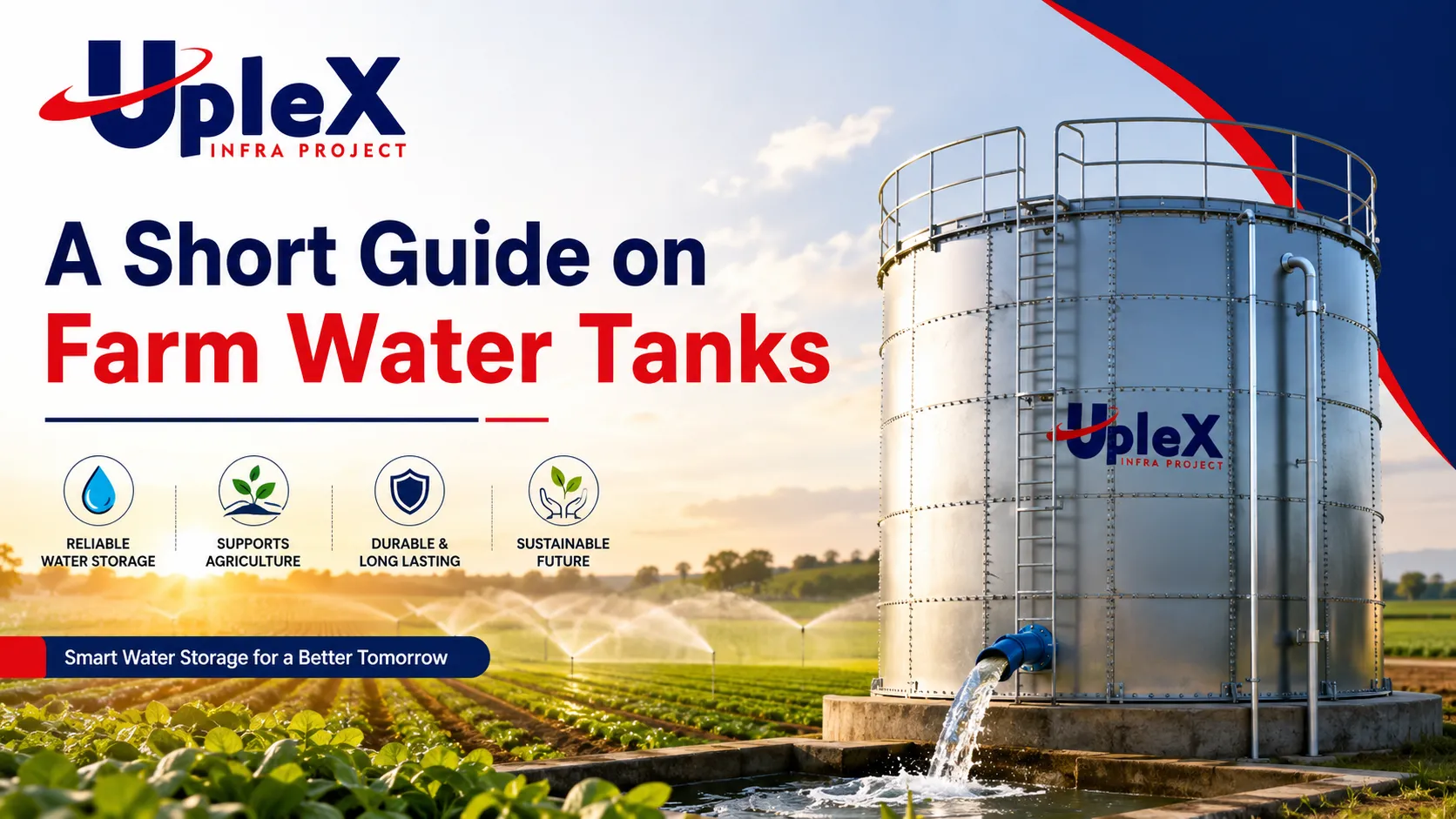
Water availability is one of the most important factors in agriculture. Rainfall is often seasonal, while crops may require a regular supply of water throughout their growing cycle. A properly planned water storage system helps farmers store water when it is available and use it when required. This is where farm water tanks become an important part of modern agricultural water management.
A well-designed agricultural water tank can be used to store water collected from rainfall, borewells, canals, irrigation systems, or other sources. The stored water can then be supplied to fields through drip irrigation, sprinkler systems, or conventional irrigation methods.
Uplex Infra Project Pvt. Ltd. provides water storage solutions for different agricultural and infrastructure requirements. In this guide, we will understand the types, applications, benefits, capacity considerations, and important factors to consider before selecting a farm water tank.
What Is a Farm Water Tank?
A farm water tank is a storage system designed to hold water for agricultural activities. These tanks can be installed on farms, agricultural properties, nurseries, greenhouses, and livestock facilities where a dependable water supply is required.
The tank stores water during periods of availability and provides an additional source during dry periods or when the regular water supply is insufficient. Depending on the project, a tank may be installed above ground or in another suitable configuration.
Modern agriculture tanks can be available in different capacities, materials, shapes, and construction designs. The right option depends on factors such as water requirement, available space, soil conditions, installation location, budget, and intended use.
Also Read: Is a Galvanized Steel Water Tank Safe for Drinking Water?
Why Are Agricultural Water Tanks Important?
Agricultural activities often depend on a reliable water supply. Even when a farm receives adequate rainfall, water may not be available at the exact time when crops require irrigation.
An agricultural water tank provides a practical way to manage this difference between water availability and water demand. Rainwater or water from other sources can be stored and used later according to the crop’s irrigation schedule.
For farms with larger water requirements, properly sized agriculture water tanks can also help reduce dependence on a single water source. This can be particularly useful during dry periods or irregular rainfall conditions.
Common Applications of Farm Water Tanks
Farm water storage systems can be used for more than just crop irrigation. Their applications depend on the size of the farm and the type of agricultural activity.
Crop Irrigation
The most common application is storing water for irrigation. Stored water can be supplied to crops through drip, sprinkler, or other irrigation systems.
Rainwater Harvesting
A farm can collect rainwater from suitable catchment areas and store it in a tank. This can help make productive use of seasonal rainfall.
Livestock Water Supply
Agricultural properties with cattle, dairy animals, poultry, or other livestock can use suitable water storage systems to maintain a regular supply.
Greenhouses and Nurseries
Greenhouses and plant nurseries require controlled and regular watering. A dedicated tank can provide water for irrigation systems used in these facilities.
Farm Processing
Some agricultural businesses also require water for washing, cleaning, processing, and other farm-related operations. A suitable storage tank can support these activities.
Types of Agriculture Water Tanks
There is no single tank design suitable for every farm. Different storage requirements may call for different tank configurations.
Modular Steel Water Tanks
Modular steel tanks are assembled using individual panels and can be supplied in different capacities. Their panel-based construction can make transportation and site installation more practical, particularly for larger projects.
Zincalume Water Tanks
Zincalume tanks use steel panels with a protective zinc-aluminium coating. They can be considered for agricultural water storage where strength, durability, and modular construction are important requirements.
Bolted Steel Tanks
Bolted tanks are assembled at the site using prefabricated components. Their modular nature can be useful when large-capacity water storage is required and transportation access is limited.
Polyethylene or Plastic Tanks
Plastic tanks are commonly used for smaller agricultural water storage requirements. They are comparatively lightweight and can be suitable where the required capacity is limited.
The selection should be based on the storage capacity, water type, site conditions, expected service requirements, and project budget.
How to Select the Right Agricultural Water Tank?
Selecting the right tank starts with calculating how much water the farm actually needs. The tank should not simply be selected based on the available space or the lowest purchase price.
Determine Water Requirement
Consider the daily or seasonal irrigation requirement of the crops. Crop type, cultivated area, irrigation method, climate, and farming schedule can all affect water demand.
Consider Water Source
Identify whether the tank will receive water from rainfall, borewell, canal, municipal supply, or another source. The availability and consistency of the source can influence the required storage capacity.
Check Available Space
The available installation area should be evaluated before selecting the tank dimensions. Access for transportation, installation, inspection, and maintenance should also be considered.
Select Suitable Material
Tank material should be selected according to the application and expected environmental conditions. Factors such as corrosion exposure, temperature, water quality, and maintenance requirements can influence the choice.
Plan for Future Requirements
If the farm is expected to expand, it may be useful to consider future water demand during the initial planning stage. A modular storage system can offer flexibility for larger agricultural projects.
Benefits of Agriculture Water Tanks
Installing a suitable water storage system can provide several practical advantages to farmers and agricultural businesses.
- Reliable Water Storage: Provides stored water when the regular supply is insufficient.
- Rainwater Utilization: Allows seasonal rainfall to be collected and stored for later use.
- Better Irrigation Planning: Supports more controlled irrigation schedules.
- Reduced Water Dependence: Provides an additional storage source for agricultural operations.
- Flexible Capacity: Tanks are available in different sizes according to project requirements.
- Efficient Water Management: Helps organize water collection, storage, and distribution.
- Multiple Applications: Suitable for irrigation, livestock, greenhouses, nurseries, and other farm activities.
- Space Utilization: Suitable tank configurations can be selected according to available installation space.
Farm Water Tanks and Water Conservation
Water conservation has become increasingly important as agricultural water requirements continue to grow. A storage tank does not create additional water, but it can help make better use of water that is already available.
For example, rainwater that might otherwise run off a farm can be collected and stored for later use. Similarly, water supplied during periods of availability can be stored instead of being used immediately.
When combined with efficient irrigation systems such as drip irrigation or sprinklers, ag water tanks can become part of a broader water management strategy. The overall effectiveness depends on proper tank sizing, water collection, distribution, irrigation efficiency, and regular maintenance.
Maintenance of Agricultural Water Tanks
Regular inspection helps maintain the performance of a farm water storage system. The tank should be checked for leakage, visible damage, corrosion where applicable, and issues around inlet and outlet connections.
Sediment and debris should also be managed according to the type of water being stored. Rainwater collection systems may require cleaning of filters, screens, gutters, and other collection components.
For larger tanks, inspection and maintenance should be carried out according to the manufacturer’s recommendations and the operating conditions of the installation.
Why Choose Uplex Infra Project Pvt. Ltd.?
Uplex Infra Project Pvt. Ltd. provides water storage solutions designed around the requirements of different agricultural, industrial, commercial, and infrastructure projects.
For farms requiring agriculture water tanks, the appropriate solution depends on storage capacity, water source, installation conditions, construction requirements, and intended application. A properly planned tank can help create a more organized approach to agricultural water storage.
Our team can help evaluate project requirements and identify a suitable tank configuration for irrigation water, rainwater storage, livestock applications, or other agricultural needs.
Final Thoughts
A farm water tank can play an important role in managing water availability throughout the agricultural cycle. Whether the objective is to store rainwater, support irrigation, maintain livestock water supply, or provide additional storage during dry periods, selecting the right tank is essential.
The best solution depends on the farm’s water requirement, available water sources, tank capacity, installation space, construction material, and future expansion plans. Agriculture tanks should therefore be selected as part of an overall water management plan rather than simply as a standalone storage product.
For farms and agricultural businesses looking for dependable ag water tanks, Uplex Infra Project Pvt. Ltd. can provide suitable water storage solutions based on specific project requirements.