
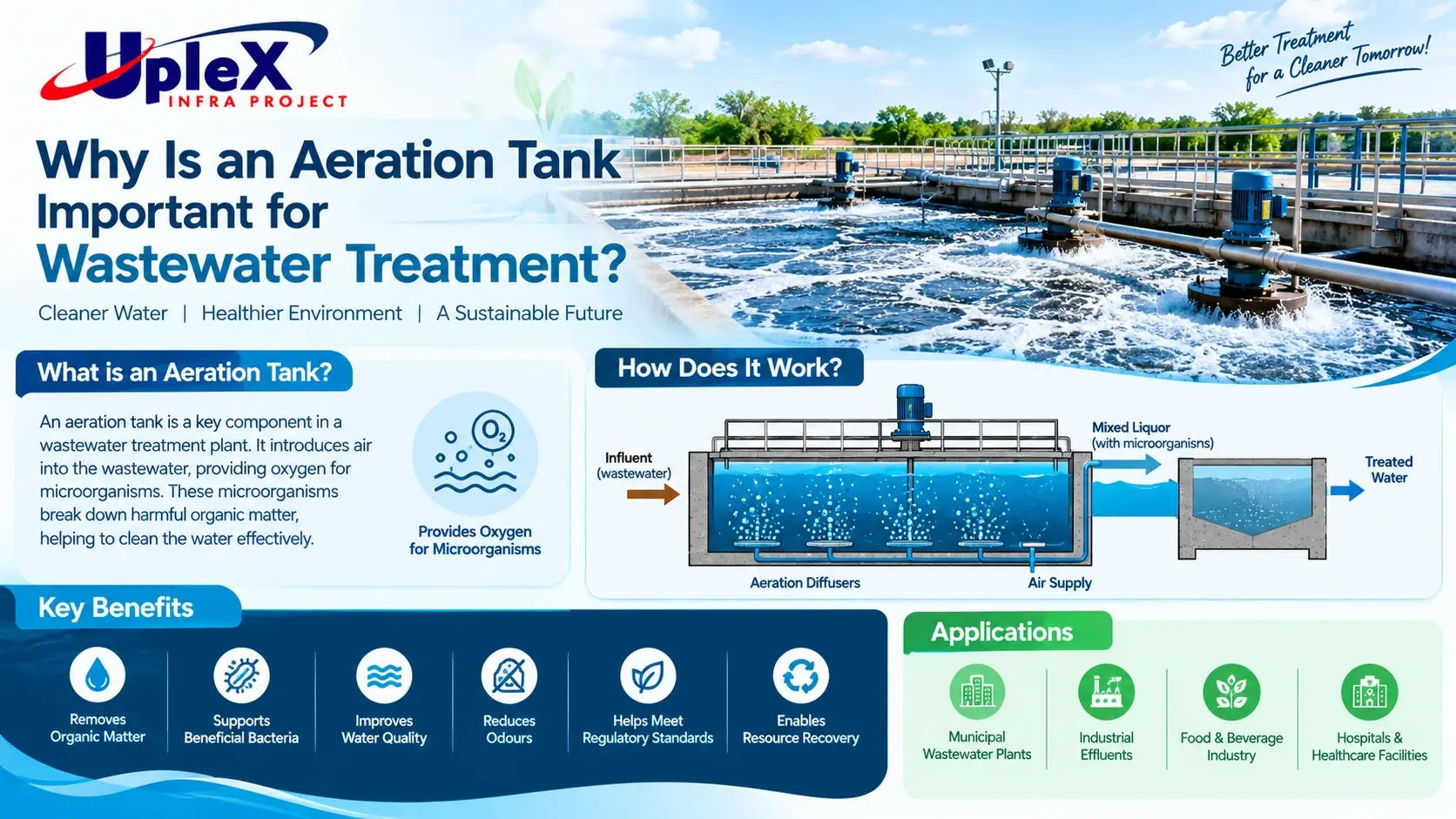
Wastewater treatment is an essential process for industries, commercial facilities, and infrastructure projects that generate used or contaminated water. Before wastewater can be safely discharged or reused, it must undergo suitable treatment to reduce organic pollutants, suspended solids, and other contaminants. One of the most important stages in many biological treatment systems is aeration.
An aeration tank provides the environment required for microorganisms to break down biodegradable organic matter. By supplying oxygen and maintaining proper mixing, it helps improve treatment efficiency and supports consistent wastewater quality.
Understanding aeration in wastewater treatment helps industries select suitable treatment processes, manage operating costs, and plan reliable wastewater infrastructure. In this guide, we will explore how aeration tanks work, their major benefits, different aeration methods, and the factors to consider when selecting a tank for an industrial project.
What Is an Aeration Tank in Wastewater Treatment?
An aeration tank is a treatment chamber where air or oxygen is introduced into wastewater to support aerobic biological activity. It is commonly used in activated sludge systems and other biological treatment processes.
Inside the tank, microorganisms consume biodegradable organic pollutants as a food source. With an adequate oxygen supply, these microorganisms convert organic matter into simpler substances, carbon dioxide, water, and additional biological growth.
The resulting mixture, commonly called mixed liquor in activated sludge systems, generally moves to a secondary clarifier. There, biological solids settle and separate from the treated water. Some settled biomass may return to the aeration tank to maintain the required microbial population.
An appropriately designed aeration tank in wastewater treatment helps maintain the conditions needed for effective biological treatment.
Also Read: DM Water Tank: Importance, Uses and Role in DM Water Plant Process
Why Is Aeration Important in Wastewater Treatment?
Aeration does more than introduce air into wastewater. It supports the biological and physical conditions that make many treatment systems effective.
1. Supports the Breakdown of Organic Pollutants
Wastewater from manufacturing facilities, food processing units, and other industries may contain biodegradable organic substances. Aerobic microorganisms use these substances during their metabolic activity.
Proper aeration supplies the oxygen required for this process, helping reduce the organic pollution load. Treatment performance depends on wastewater composition, microbial activity, temperature, and the available oxygen supply.
2. Helps Reduce BOD and COD
Biochemical Oxygen Demand (BOD) indicates the oxygen microorganisms require to break down biodegradable organic matter under specified test conditions. Chemical Oxygen Demand (COD) measures the oxygen equivalent associated with chemically oxidisable substances in water.
Effective biological treatment can reduce BOD and, depending on the wastewater characteristics, may also reduce COD. The extent of removal depends on the treatment design and the nature of the pollutants present.
This makes wastewater treatment aeration an important consideration for facilities that need to manage effluent quality before discharge or further treatment.
3. Maintains Adequate Dissolved Oxygen
Microorganisms require sufficient dissolved oxygen to remain active under aerobic conditions. When oxygen levels become too low, biological treatment may become less effective, and undesirable operating conditions can develop.
A properly selected aeration system helps deliver oxygen throughout the tank. Operators can monitor dissolved oxygen and adjust the air supply according to treatment requirements.
4. Improves Mixing Inside the Tank
Aeration creates movement within the wastewater, helping keep biological solids suspended and bringing microorganisms into contact with organic pollutants.
Uniform mixing can reduce stagnant zones and improve the use of the tank’s treatment volume. However, the mixing intensity must suit the process and should not unnecessarily increase energy consumption.
5. Supports Nitrogen Removal Processes
Certain aerobic treatment stages support nitrification, a biological process in which specialised microorganisms convert ammonia into nitrite and then nitrate.
This process requires adequate oxygen and suitable environmental conditions. Complete nitrogen removal usually requires additional process stages, such as denitrification under anoxic conditions. Aeration alone does not remove every form of nitrogen.
How Does an Aeration Tank Work?
The wastewater treatment aeration process generally involves the following stages:
Step 1: Wastewater Enters the Treatment System
Wastewater first passes through the necessary preliminary treatment equipment, such as screens and grit removal units. Depending on the system, primary clarification or other pretreatment may follow.
These stages remove materials that could interfere with downstream biological treatment.
Step 2: Air Is Supplied to the Tank
Blowers, diffusers, surface aerators, or other suitable equipment introduce air into the wastewater. The oxygen transfers from the air into the liquid, creating conditions that support aerobic microorganisms.
Step 3: Microorganisms Break Down Organic Matter
Microorganisms consume biodegradable contaminants and grow as biological solids. The tank provides the contact time, oxygen, and mixing required for the selected biological process.
Step 4: Biological Solids Are Separated
After the aeration stage, the mixed liquor typically flows to a clarifier or another solids-separation unit. Biological solids are separated from the treated water.
Depending on the system design, some biomass is returned to the aeration tank, while excess sludge is removed for further processing.
Step 5: Water Moves to Further Treatment or Reuse
The clarified water may undergo filtration, disinfection, nutrient removal, or other polishing steps. The required treatment depends on the intended reuse application and applicable discharge standards.
Types of Aeration Systems Used in Wastewater Treatment
Selecting the right aeration method is important for oxygen transfer, mixing, energy efficiency, and maintenance.
Diffused Aeration System
In diffused aeration, blowers supply compressed air through diffusers installed within the tank. The diffusers release air bubbles into the wastewater.
Fine-bubble diffusers can provide efficient oxygen transfer under suitable operating conditions, while coarse-bubble systems may be useful where mixing, durability, or specific process requirements are priorities.
Mechanical Surface Aeration
Mechanical aerators agitate wastewater at or near the surface, increasing contact between the liquid and atmospheric air. They also provide mixing and are used in various biological treatment applications.
Their suitability depends on tank geometry, treatment capacity, oxygen demand, and operating conditions.
Subsurface Mechanical Aeration
Some systems use submerged mechanical equipment to introduce air and mix wastewater. These arrangements may suit particular industrial processes where a combination of oxygen transfer and mixing is needed.
The appropriate option should be selected through process evaluation rather than equipment cost alone.
Key Factors to Consider When Selecting an Aeration Tank
A tank should be designed around the treatment process, wastewater characteristics, and operating requirements. Important considerations include:
- Wastewater flow rate: Average and peak flows influence tank volume and hydraulic capacity.
- Pollutant concentration: BOD, COD, suspended solids, and ammonia levels help determine treatment requirements.
- Oxygen demand: The aeration equipment must meet the process’s oxygen-transfer requirements under actual operating conditions.
- Tank material: Material selection should account for corrosion exposure, wastewater chemistry, structural loads, and service life.
- Tank dimensions: Depth, geometry, and available space affect mixing, oxygen transfer, and installation.
- Energy consumption: Blower or aerator efficiency can significantly influence long-term operating costs.
- Maintenance access: Equipment should be accessible for inspection, cleaning, and replacement.
- Downstream treatment: Clarification, sludge handling, disinfection, and reuse requirements must be considered as part of the overall design.
A well-planned aeration system balances treatment performance, structural reliability, energy use, and maintenance needs.
Applications of Aeration Tanks in Industrial and Municipal Projects
Aeration tanks are used in a wide range of wastewater treatment applications, including:
- Manufacturing industries: Treatment of biodegradable pollutants generated during production.
- Food and beverage facilities: Biological treatment of wastewater containing organic residues.
- Municipal sewage treatment plants: Secondary treatment of domestic sewage.
- Commercial complexes: Treatment of wastewater generated by offices, residential developments, and large facilities.
- Pharmaceutical and chemical facilities: Biological treatment where wastewater characteristics are suitable and required pretreatment has been provided.
Industrial wastewater varies considerably. Toxic chemicals, extreme pH levels, high salinity, or other inhibitory substances may require specialised pretreatment before biological treatment can operate effectively.
Why Choose a Reliable Industrial Tank Manufacturer?
The performance of a wastewater treatment system depends on more than the aeration equipment. Tank construction, material compatibility, structural design, installation quality, and maintenance planning all contribute to long-term reliability.
Uplex Infra Project Pvt. Ltd. provides industrial infrastructure solutions, including water storage tanks, Glass Fused-to-Steel tanks, Zincalume tanks, grain storage silos, and related material-handling solutions. The company supports projects through manufacturing, supply, installation, and project execution services.
For projects involving wastewater treatment infrastructure, selecting the tank structure should begin with a clear assessment of the intended application, operating environment, capacity, and engineering requirements. Where a project requires an aeration basin or process tank, confirm the availability and suitability of the required configuration with the engineering team.
A reliable project partner can help coordinate material selection, fabrication requirements, installation planning, and other relevant infrastructure needs.
Conclusion
Aeration is a critical part of many biological wastewater treatment systems because it supplies oxygen, supports microbial activity, and helps maintain effective mixing. A correctly designed aeration tank can improve organic pollutant removal and support more consistent treatment performance.
For industrial and municipal projects, the right solution depends on wastewater characteristics, oxygen demand, tank design, equipment selection, and downstream treatment requirements. Careful planning helps balance treatment efficiency with energy consumption and long-term maintenance.
Uplex Infra Project Pvt. Ltd. offers industrial tank and infrastructure solutions for projects with specific storage and engineering requirements. Contact the team to discuss your project needs and identify suitable infrastructure options.
Also Read: Zinc Aluminium Water Tank Manufacturers
Frequently Asked Questions
1. What is the main purpose of an aeration tank?
The main purpose is to supply oxygen and provide mixing so aerobic microorganisms can break down biodegradable organic pollutants in wastewater.
2. How does aeration help wastewater treatment?
Aeration supports microbial activity, improves contact between microorganisms and pollutants, and can help reduce BOD and some COD under suitable treatment conditions.
3. What are the common types of wastewater aeration?
Common methods include diffused aeration, mechanical surface aeration, and selected subsurface aeration systems.
4. Is aeration required in every wastewater treatment plant?
No. Aeration is essential for many aerobic biological processes, but other treatment technologies may use different mechanisms or operate under anaerobic or anoxic conditions.
5. What factors affect aeration tank design?
Key factors include wastewater flow, pollutant loading, oxygen demand, tank depth and geometry, aeration equipment, material compatibility, energy efficiency, and maintenance access.
6. How can industries select the right aeration tank?
Industries should evaluate their wastewater characteristics, required treatment performance, operating conditions, available space, equipment needs, and applicable environmental requirements before finalising a design.