Water is used in almost every industrial process, but ordinary water is not suitable for applications where dissolved minerals and salts can affect equipment or product quality. This is where DM (Demineralized) water becomes important. DM water is treated to remove dissolved ions and unwanted mineral content, making it suitable for applications that require low-mineral water.
A DM water storage tank is an important part of a DM water plant because it stores the treated water safely and makes it available whenever the process requires it. Proper tank selection and DM water storage tank design can make a significant difference in water quality, storage capacity, system performance, and maintenance.
In this guide, we will understand what a DM water tank is, why it is important, how it is used, and what role it plays in the overall DM water plant process.
What Is a DM Water Tank?
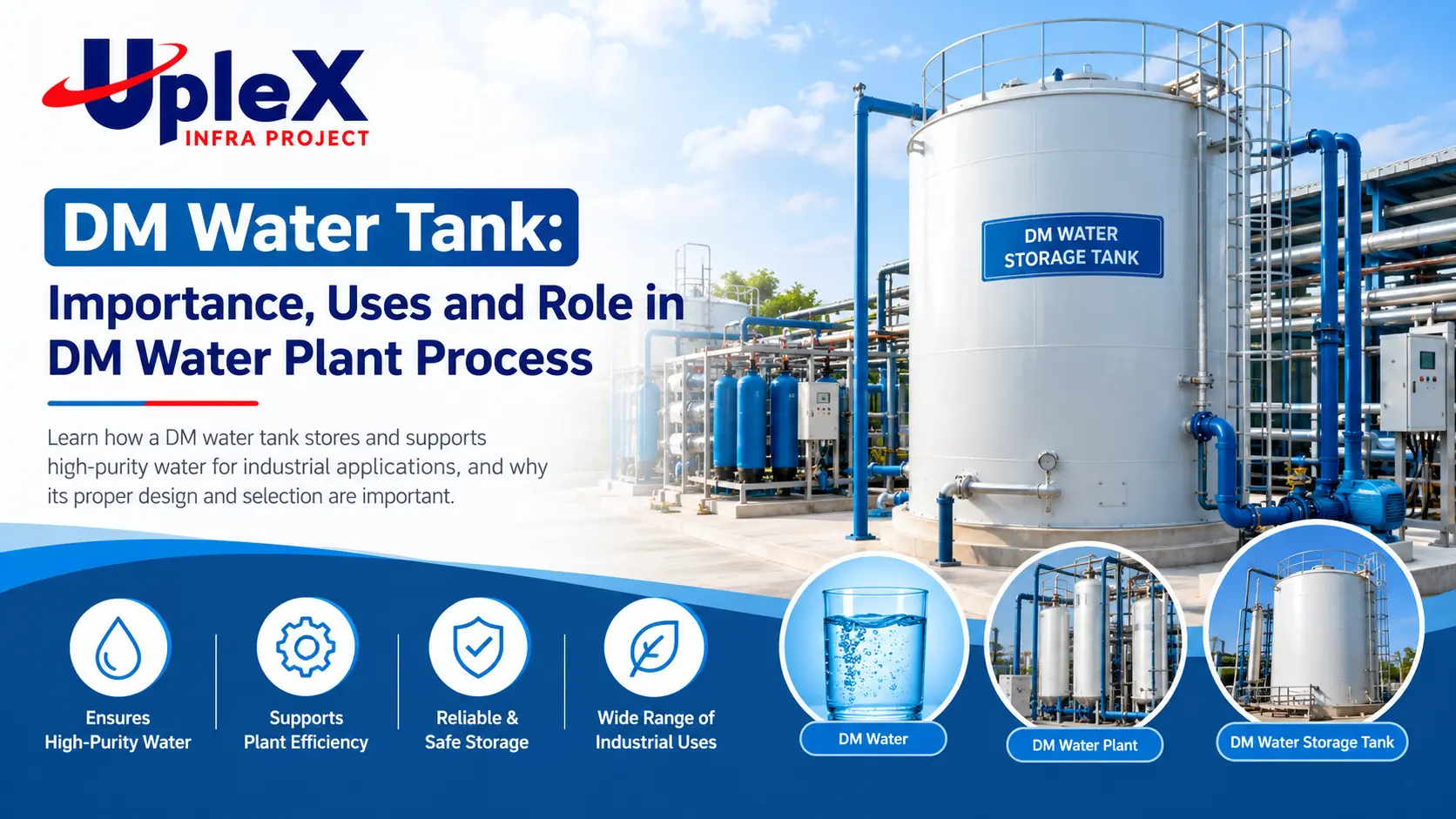
A DM water tank is a storage vessel used to collect and store demineralized water produced by a DM water treatment plant. Since DM water has very low levels of dissolved minerals, the tank must be suitable for maintaining the quality of the treated water.
The tank is generally connected to the DM water treatment system and the downstream industrial process. Once water passes through the required treatment stages, it can be transferred to the storage tank. From there, the stored water can be supplied to boilers, manufacturing equipment, laboratories, cooling systems, or other processes according to the application. The tank capacity depends on factors such as water production, daily consumption, peak demand, and the required storage time.
Also Read: Grain Storage Silos: Engineering, Design & Storage Guide
Why Is a DM Water Storage Tank Important?
The main purpose of a DM water storage tank is to provide a reliable supply of treated water between production and consumption.
For example, a DM plant may produce water continuously or during specific operating hours, while the industrial process may require water at different times. The storage tank acts as a buffer between these two operations.
Some important benefits include:
- Continuous Water Availability: Stored DM water can be supplied when the production process requires it.
- Better Process Management: The tank helps balance water production and consumption.
- Safe Storage: A properly selected tank protects treated water from unnecessary contamination.
- Operational Flexibility: Industries can maintain a reserve of treated water for changing production requirements.
- Easy Distribution: The stored water can be pumped to different points of use through a dedicated piping system.
Role of DM Water Tank in DM Water Plant Process
The DM water tank is not normally the equipment that removes minerals from water. Instead, it acts as a storage and distribution point after the demineralization process.
A simplified DM water plant process can be understood as:
Raw Water → Pre-Treatment → Ion Exchange/Demineralization → Treated DM Water → DM Water Storage Tank → Industrial Application
Depending on the plant configuration, additional treatment stages may be included before or after demineralization.
Once the water has been treated, it is transferred to the storage tank. The tank then supplies water to the required process through pumps and pipelines.
This arrangement helps maintain a steady water supply without requiring the DM plant and consuming equipment to operate at exactly the same flow rate.
DM Water Storage Tank Design
DM water storage tank design should be based on the actual requirements of the plant rather than using a standard size for every application.
Several factors should be considered during the design process.
1. Storage Capacity
The first consideration is the amount of DM water required by the facility. The tank should have enough capacity to handle normal consumption as well as expected variations in demand.
2. Material Selection
The tank material is an important consideration because the storage vessel should be compatible with demineralized water and the operating environment. The appropriate material depends on factors such as water quality, temperature, tank size, installation conditions, and project requirements.
3. Tank Configuration
The tank can be designed in a vertical or horizontal configuration depending on available space, storage volume, installation requirements, and plant layout.
4. Inlet and Outlet Arrangement
Properly positioned inlet and outlet connections help maintain smooth water flow and simplify integration with the DM plant and distribution system.
5. Maintenance Access
Manholes, inspection openings, drains, vents, and other suitable arrangements can be included to make cleaning, inspection, and maintenance easier.
6. Protection Against Contamination
Since DM water has low dissolved mineral content, maintaining water quality during storage is important. The tank design should minimize the possibility of contamination from dust, external particles, unsuitable materials, or stagnant conditions.
Common Uses of DM Water
DM water is used in many industries where low-mineral water is required. Some common applications include:
Boiler Feed Water
DM water is widely used as boiler feed water in industrial facilities. Low-mineral water can help reduce the risk of scale and deposits in boiler systems when used as part of a properly designed water treatment program.
Pharmaceutical Industry
Pharmaceutical manufacturing and related processes may require treated water with controlled quality. DM water can be used for specific process and utility applications depending on the required water grade.
Chemical Industry
Chemical plants often require water with controlled mineral content for manufacturing and process operations.
Power Plants
DM water is used in several utility and process applications in power generation facilities, including systems associated with steam generation.
Textile Industry
Textile manufacturing can use treated water in processes where mineral content may affect production quality or equipment performance.
Electronics Industry
Some electronic manufacturing processes require highly treated water because dissolved minerals can interfere with sensitive operations.
Features of a Good DM Water Storage Tank
A well-designed DM water storage tank should provide safe and reliable storage while being easy to operate and maintain.
Important features may include:
- Strong and durable construction
- Suitable material for DM water storage
- Properly designed inlet and outlet connections
- Adequate storage capacity
- Inspection and maintenance access
- Proper venting arrangements
- Efficient drainage
- Compatibility with the plant’s piping system
- Smooth and practical internal design
- Customizable dimensions according to site requirements
The exact features depend on the application, tank capacity, installation location, and water quality requirements.
How to Select the Right DM Water Tank?
Choosing the right tank requires more than simply checking its capacity. Industries should consider their complete water treatment and storage requirements.
Important factors include:
- Water demand: Calculate average and peak DM water consumption.
- Storage requirement: Decide how much treated water needs to be available as reserve.
- Tank material: Select a material compatible with the water and operating conditions.
- Available space: Consider the installation area’s height, width, access, and foundation requirements.
- Operating conditions: Temperature, pressure, outdoor or indoor installation, and other site conditions should be evaluated.
- Future expansion: If production capacity is expected to increase, the storage arrangement should account for future requirements where practical.
Importance of Proper DM Water Storage
Producing high-quality DM water is only one part of a successful water treatment system. The treated water must also be stored and transferred properly.
An unsuitable storage tank or poorly planned storage arrangement can affect water quality and create operational problems. Properly designed storage helps maintain a dependable supply of treated water while supporting the overall efficiency of the DM plant.
For this reason, DM water storage tank design should be considered an important part of the complete water treatment system rather than as a separate storage requirement.
Conclusion
A DM water storage tank plays an important role in industries that depend on demineralized water for their processes and utilities. It provides a convenient storage point between water treatment and final use, helping maintain a steady supply according to changing operational requirements.
From tank capacity and material selection to inlet-outlet arrangements and maintenance access, every part of the DM water storage tank design should be planned according to the specific application. A properly designed tank can support reliable water storage, efficient distribution, and better overall management of DM water.
Uplex Infra Project Pvt. Ltd. can provide industrial water storage solutions designed around specific project requirements, helping industries create practical and reliable water management systems.