When selecting a water storage solution for residential, commercial, or industrial applications, two materials are commonly discussed—GRP and FRP. While these terms are often used interchangeably, they are not exactly the same. Understanding the difference between the two helps you choose the right water tank based on durability, strength, application, and budget.
In this blog, we’ll explain the grp full form, frp tank full form, grp tank full form, compare GRP vs FRP, and help you determine which water tank is best for your project.
What is GRP?
The GRP full form is Glass Reinforced Plastic. It is a composite material manufactured by reinforcing plastic resin with fine glass fibers. This combination produces a lightweight yet highly durable material that offers excellent mechanical strength and corrosion resistance.
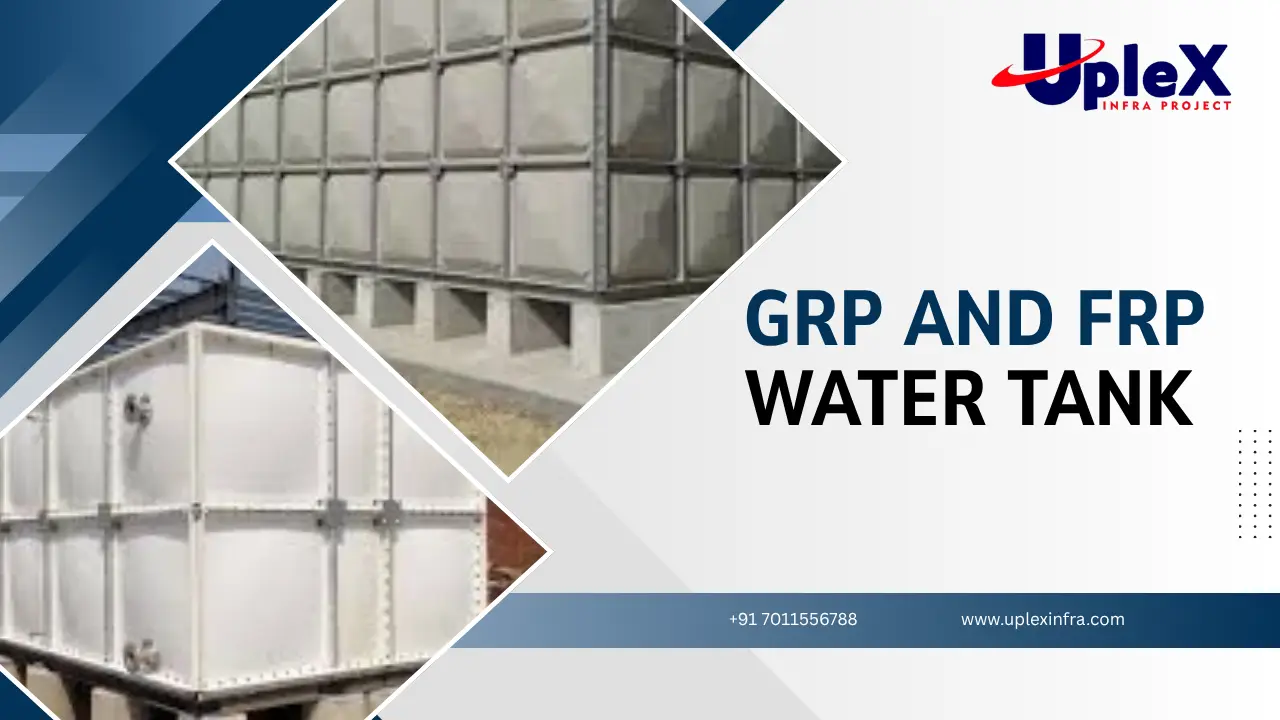
A GRP tank full form is Glass Reinforced Plastic Tank, which is widely used for storing potable water, rainwater, process water, and fire-fighting water. GRP tanks are typically manufactured in modular panels, making them easy to transport, assemble, expand, and maintain.
Because of their modular construction and long service life, GRP water tanks are increasingly preferred for high-capacity water storage projects.
What is FRP?
The FRP tank full form is Fiber Reinforced Plastic Tank. FRP is a broad category of composite materials in which plastic is reinforced using fibers such as glass fiber, carbon fiber, or aramid fiber.
In the water storage industry, most FRP tanks are reinforced with glass fibers, which is why the terms FRP and GRP are often used together. However, technically speaking, GRP is a type of FRP.
An FRP tank is widely used for storing water, chemicals, wastewater, industrial liquids, and process fluids because it offers excellent corrosion resistance, low maintenance, and long-lasting performance.
GRP vs FRP – What is the Difference?
Although both materials are composite products with similar properties, there are some important differences in terminology and applications.
| Feature | GRP Water Tank | FRP Water Tank |
|---|---|---|
| Full Form | Glass Reinforced Plastic | Fiber Reinforced Plastic |
| Reinforcement Material | Glass Fibers Only | Glass, Carbon or Other Fibers |
| Common Usage | Water Storage Tanks | Water, Chemical & Industrial Tanks |
| Construction | Mostly Modular Panel Design | Panel or One-Piece Moulded Design |
| Corrosion Resistance | Excellent | Excellent |
| Strength | High | High |
| Weight | Lightweight | Lightweight |
| Maintenance | Very Low | Very Low |
| Service Life | 25–30+ Years | 20–30+ Years |
| Best Application | Drinking Water Storage | Water & Industrial Liquid Storage |
From the comparison above, it is clear that GRP vs FRP is largely a matter of terminology. Every GRP tank is an FRP tank, but not every FRP product is necessarily classified as GRP because FRP may use different reinforcing fibers.
Advantages of GRP Water Tanks
GRP water tanks have become one of the most preferred water storage solutions due to their durability and modular construction.
Some major advantages include:
- Excellent corrosion resistance
- UV-resistant construction
- Lightweight yet extremely strong
- Leak-proof modular panel design
- Easy transportation and installation
- Hygienic for potable water storage
- Long service life
- Low maintenance requirements
- Easy future capacity expansion
- Suitable for indoor and outdoor installations
These advantages make GRP tanks suitable for apartments, commercial buildings, hospitals, hotels, schools, industries, and municipal projects.
Benefits of FRP Tanks
An FRP tank is widely used because of its versatility and excellent resistance to chemicals and environmental conditions.
Key benefits include:
- High structural strength
- Rust and corrosion resistance
- Chemical-resistant construction
- Lightweight design
- Long operational life
- Low maintenance cost
- Easy fabrication in different sizes
- Excellent weather resistance
- Suitable for industrial applications
- Cost-effective over the long term
FRP tanks are commonly used in chemical industries, wastewater treatment plants, pharmaceutical units, food processing plants, and industrial manufacturing facilities.
Which Tank is Better for Water Storage?
If your primary requirement is storing drinking water or large quantities of domestic water, a GRP water tank is generally the preferred choice. Its modular construction, hygienic interior surface, and easy installation make it ideal for residential and commercial buildings.
On the other hand, if your application involves storing chemicals, industrial liquids, or process water, an FRP tank may be the better option because of its excellent chemical resistance and flexible manufacturing options.
The right choice ultimately depends on:
- Water storage capacity
- Type of liquid being stored
- Installation location
- Available space
- Environmental conditions
- Budget
- Future expansion requirements
Consulting an experienced manufacturer helps ensure you select the most suitable tank for your application.
Applications of GRP and FRP Water Tanks
Both GRP and FRP tanks are used across a wide range of industries and infrastructure projects.
Common applications include:
- Residential Apartments
- Commercial Buildings
- Hotels & Resorts
- Hospitals
- Educational Institutions
- Manufacturing Industries
- Food Processing Units
- Pharmaceutical Plants
- Fire Fighting Systems
- Rainwater Harvesting Projects
- Municipal Water Supply
- Industrial Water Storage
- Wastewater Treatment Plants
Their durability, corrosion resistance, and low maintenance make them a dependable solution for long-term water storage.
Why Choose Uplex Infra Project Pvt. Ltd.?
At Uplex Infra Project Pvt. Ltd., we manufacture and supply premium-quality modular water storage tanks designed to meet diverse residential, commercial, and industrial requirements. Our tanks are manufactured using high-grade materials, precision engineering, and strict quality standards to ensure durability, hygiene, and reliable performance.
Our advantages include:
- Premium-quality modular tank systems
- High-strength construction
- Leak-proof design
- Corrosion and UV resistance
- Customized storage capacities
- Easy installation and maintenance
- Long service life
- Competitive pricing
- Professional technical support
- PAN India project execution
Whether you need a water storage solution for a residential complex, industrial facility, commercial building, or infrastructure project, our team can recommend the ideal tank based on your requirements.
Conclusion
Understanding the difference between GRP vs FRP helps you make an informed decision when selecting a water storage solution. The grp full form is Glass Reinforced Plastic, while the frp tank full form is Fiber Reinforced Plastic. Since GRP uses glass fibers as reinforcement, it is technically a type of FRP.
Both materials offer excellent durability, corrosion resistance, and long service life. However, GRP tanks are generally preferred for modular potable water storage, whereas FRP tanks are commonly used for both water and industrial liquid storage. By evaluating your application, storage capacity, and environmental conditions, you can choose the right tank for reliable, long-term performance.
If you’re looking for high-quality modular water storage solutions, Uplex Infra Project Pvt. Ltd. offers customized tanks designed to deliver efficiency, durability, and excellent value for your investment.